Examples of Interactive AI Tour Experiences for Travelers
Discover examples of interactive AI tour experiences that personalize your journey. Explore art and culture like never before.

Interactive AI tour experiences are guided journeys powered by artificial intelligence that deliver personalized, conversational, and immersive explorations in real time. The best examples of interactive AI tour experiences, from Qatar Museums’ AI Art Specialist to Kukan AI’s digital twins, prove that AI has fundamentally shifted tours from static presentations to dynamic, adaptive conversations. Whether you’re a history buff standing before a centuries-old artifact or a curious urban explorer wandering unfamiliar streets, AI now acts as your most knowledgeable, endlessly patient guide.
1. Examples of interactive AI tour experiences: personalized art and cultural tours
Personalized AI-guided tours curate visits based on your unique interests through AI chat, and the Qatar Museums AI Art Specialist is the clearest proof. The system supports four languages , specifically English, Arabic, French, and Chinese, and integrates directly with Uber and Google Maps for real-time navigation between venues. That multilingual reach means a French-speaking visitor and a Mandarin-speaking visitor can receive equally rich, contextually relevant experiences at the same exhibition.
The AI Art Specialist does more than translate. It identifies artworks on demand, surfaces historical context, and builds a personalized itinerary around your stated preferences before you even step through the door. This shifts the tour from a fixed script to a living conversation shaped by what you actually care about.
Key features of personalized AI art tours include:
- On-demand artwork identification and contextual storytelling
- Itinerary curation based on visitor interests and time available
- Multilingual support across major global languages
- Real-time navigation integration with mapping and ride-sharing apps
- Adaptive pacing that responds to visitor questions mid-tour
Pro Tip: Before starting an AI-guided art tour, spend two minutes telling the AI your specific interests, such as a particular era, medium, or cultural region. The more specific your input, the more tailored and surprising the tour becomes.
2. AI avatars and robots that bring museum tours to life
AI avatars represent the clearest shift from passive audio guides to participatory, responsive experiences. Musa, the 3D digital avatar at Milan’s Adi Design Museum, suggests personalized routes, answers real-time questions, and integrates multimedia content based on what each visitor chooses to explore. Musa does not follow a linear script. It adapts its storytelling to visitor choices, making every tour genuinely different.
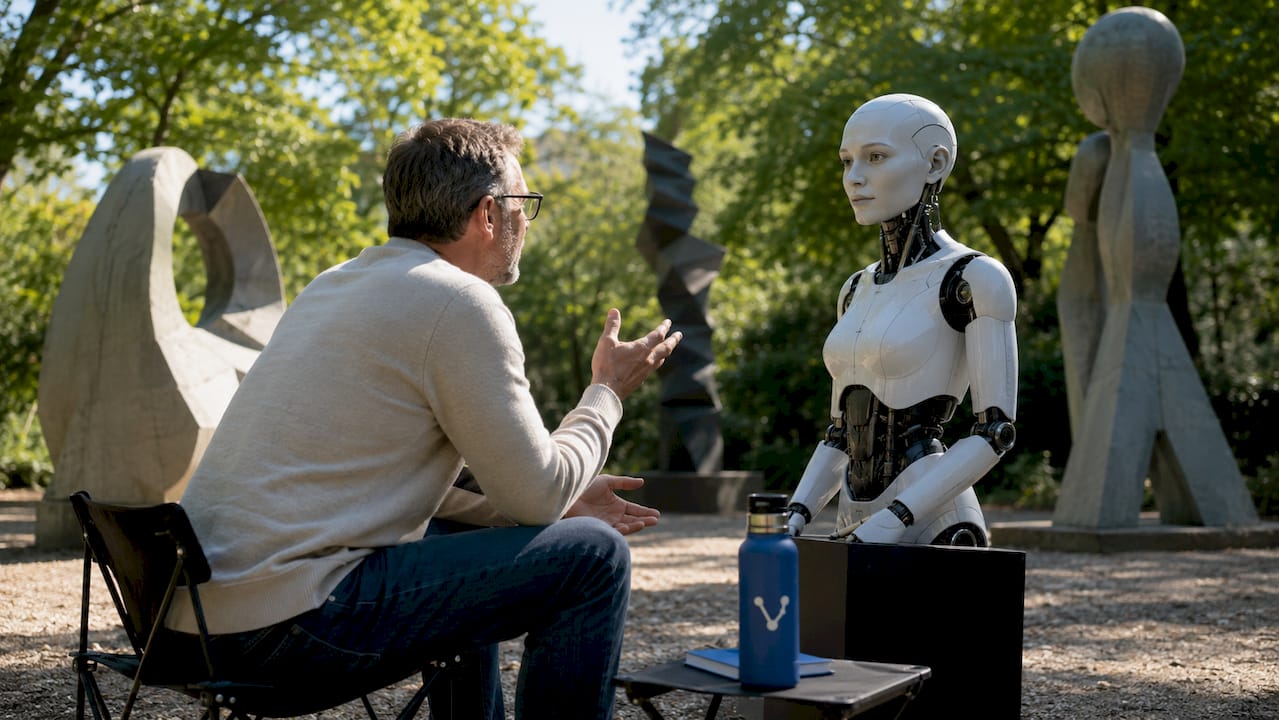
The Nuha robot from Senserbot takes this further into physical space. Nuha operates autonomously in museums and galleries, navigating independently while holding real-time, two-way conversations with visitors in multiple languages. It also collects visitor analytics, giving institutions data on which exhibits generate the most engagement.
Key benefits of AI avatars and robots in tours include:
- Participatory storytelling that responds to visitor questions in real time
- Autonomous navigation through physical museum spaces
- Multilingual two-way conversation without human staff involvement
- Visitor analytics that help institutions improve exhibit design
- Multimedia integration, including images, video, and audio, triggered by visitor interest
Pro Tip: When interacting with an AI avatar like Musa, ask follow-up questions rather than accepting the first answer. These systems are built for depth, and a second or third question often unlocks the most interesting content.
3. AI-powered virtual tours with conversational digital twins
Kukan AI defines the current standard for AI virtual tours. Its platform runs 24/7 conversational virtual tours using digital twins that support more than 40 languages and answer context-aware questions about exhibits, neighborhood amenities, and surrounding areas. That 40-plus language capability means a museum in Tokyo can serve a visitor in São Paulo without any human intermediary.
The practical value for remote audiences is significant. A traveler who cannot visit a destination physically can still receive a rich, interactive experience that mimics the spatial and conversational qualities of being there. Kukan AI’s digital twins answer location-specific questions, guide visitors through digital environments, and mimic natural human movement to boost engagement far beyond what static video tours deliver.
TourFlow, an open-source AI tour engine, adds another layer of technical sophistication. It uses a Strategy Pattern to manage non-linear, branching tour paths, meaning the conversation can move in any direction based on visitor input rather than following a predetermined sequence.
4. How AI integration techniques power fluid tour conversations
The quality of an interactive AI tour conversation depends almost entirely on its underlying architecture. TourFlow’s engine decouples AI personality from navigation logic , which means developers can update the conversational tone of a guide without touching the spatial routing system. That separation makes tours easier to maintain and faster to improve.
Multi-modal processing is the other critical factor. When speech-to-text and text-to-speech run simultaneously in the main orchestration loop, the system avoids interaction lag and produces conversations that feel natural rather than mechanical. Layered audio processing, where voice input is handled separately from voice output, creates noticeable delays that break immersion.
Key architectural features that define high-quality AI tour interactions:
- Decoupled AI personality and navigation logic for independent updates
- Simultaneous speech-to-text and text-to-speech processing
- Strategy Pattern for non-linear, branching conversation paths
- Hub-and-spoke navigation models that let visitors jump between topics freely
- Context retention across multiple exchanges within a single tour session
Pro Tip: When evaluating an AI tour app, ask whether it supports follow-up questions mid-tour. Apps that only respond to preset prompts are using basic scripting, not true conversational AI. The difference in experience is immediate.
5. GPS-triggered AI narration and the spaces between landmarks
GPS-triggered AI narration captures something traditional audio guides completely miss: the character of the spaces between landmarks. The Dex app uses GPS-enabled real-time narration to describe the surrounding ambiance, local history, and urban texture as you move through a neighborhood, not just when you arrive at a named site. Walking past a century-old bakery or a street corner with a forgotten story becomes part of the tour.
This approach transforms the experience from a checklist of attractions into a living portrait of a place. The AI reads your location continuously and delivers narration that matches what you are actually seeing and feeling at that moment. For urban explorers and independent travelers, this is the closest thing to having a local friend walk beside you.
6. How to choose the best interactive AI tours for your travel style
The right AI tour depends on what kind of traveler you are. Art lovers benefit most from platforms like Qatar Museums’ AI Art Specialist, which offers deep cultural context and on-demand artwork identification. Urban explorers get more value from GPS-triggered apps like Dex, which narrate the living texture of a city as you move through it. Virtual tourists and remote audiences are best served by Kukan AI’s digital twin platform, which delivers full conversational tours without requiring physical presence.
When comparing interactive AI travel experiences, prioritize these criteria:
- Personalization depth: Can the AI adapt its content to your stated interests, or does it follow a fixed script?
- Language options: Does the platform support your language natively, not just through basic translation?
- Multimodal input and output: Can you speak to the guide, or are you limited to text?
- Real-time responsiveness: Does the AI answer follow-up questions, or only respond to preset triggers?
- Offline capability: Can you access the tour without a strong data connection?
Votura covers more than 500 cities with 1,400 audio tours and combines expert narration with real-time AI assistance. Travelers can ask questions about their surroundings as they walk, making it one of the most practical options for independent explorers who want depth without a fixed schedule.
Key takeaways
The most effective interactive AI tour experiences combine personalized engagement, real-time conversational AI, and multimodal input to transform exploration from a passive activity into an active, adaptive discovery.
Why AI tours are changing how I think about travel
I spent years believing that the best travel experiences required a human guide. A great guide reads the room, adjusts the story, and knows when to linger. What I did not expect was how quickly AI would replicate that quality, and in some cases exceed it.
The shift that genuinely surprised me was not the technology itself but the participatory quality it unlocks. Musa at the Adi Design Museum does not just narrate. It responds. That distinction matters more than it sounds. When a tour responds to your curiosity rather than delivering a monologue, you stop being an audience and start being a participant.
The challenge I see is not technical. It is adoption. Many travelers still reach for a printed map or a human-led group tour out of habit. The irony is that AI tours often deliver more personalized depth than any group tour can, because the AI is talking only to you.
The convergence of AI with augmented reality and location-aware sensors is where this gets genuinely exciting. Future tours will not just tell you what you are looking at. They will overlay history onto the physical world in real time, triggered by exactly where you are standing. For travelers who want to go deeper, the tools are already here. The best move is to start using them.
"— Eugene"
Votura brings AI-guided exploration to your next trip
Votura is built for travelers who want the depth of a guided tour and the freedom of going at their own pace. With 1,400 self-guided audio tours across more than 500 cities, the app combines expert narration with real-time AI assistance so you can ask questions about what you see as you walk.
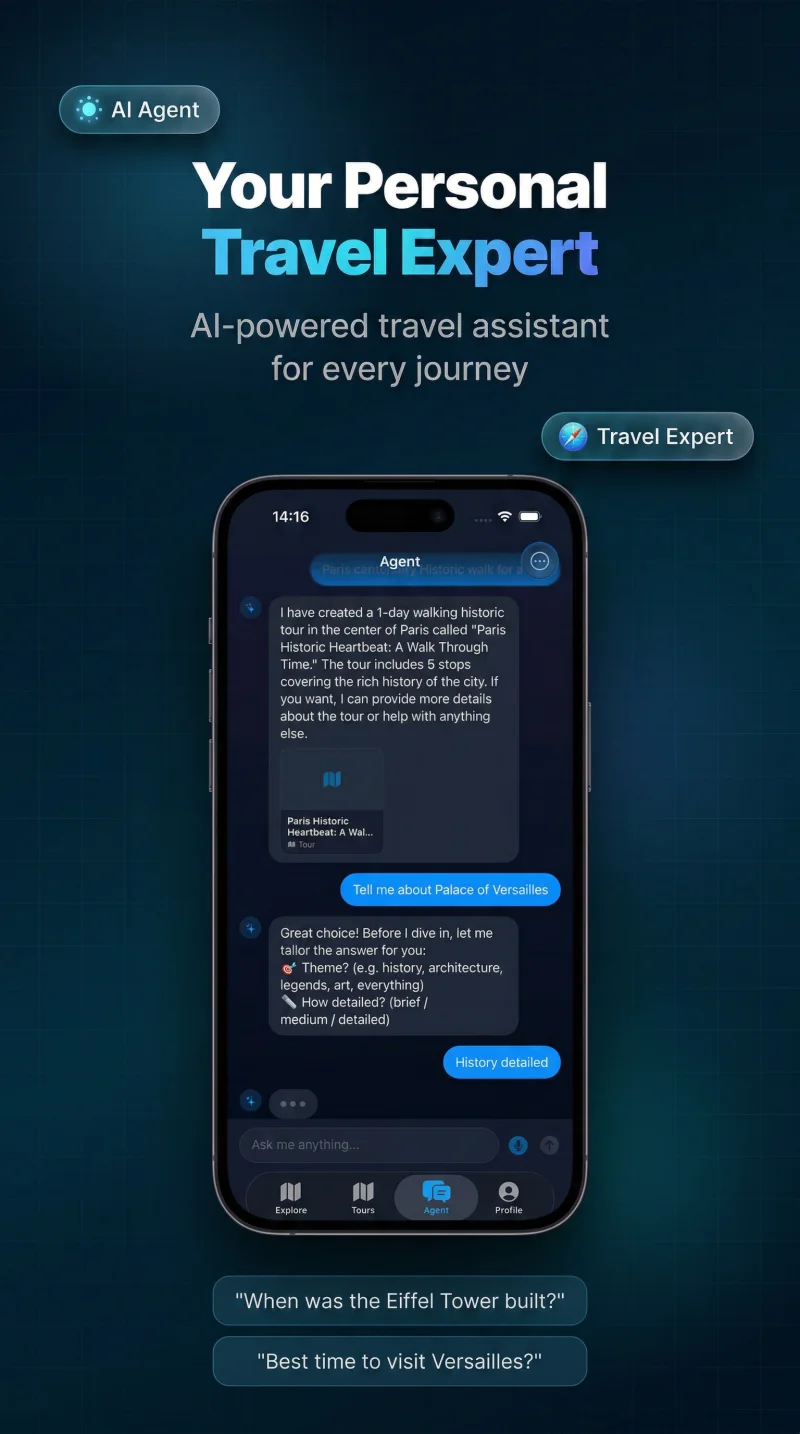
Votura holds a 4.5-star rating and covers destinations from iconic landmarks to hidden neighborhood gems. Whether you are planning a weekend in a new city or a longer trip abroad, Votura gives you a knowledgeable companion that adapts to your curiosity. Download the app and let your next walk tell you something you did not know to ask.
FAQ
What are interactive AI tour experiences?
Interactive AI tour experiences are guided tours powered by artificial intelligence that deliver personalized, real-time, and conversational exploration. They adapt to visitor interests, support multiple languages, and respond to questions on demand.
Which platforms offer the best AI virtual tours?
Kukan AI leads for virtual access, supporting 40+ languages with conversational digital twins available around the clock. Qatar Museums’ AI Art Specialist and Votura are strong options for on-site and self-guided walking tours respectively.
How does GPS improve AI tour narration?
GPS-triggered AI narration delivers location-specific content as you move, including the character of streets and spaces between landmarks. The Dex app uses this approach to create a local-friend experience rather than a landmark checklist.
Can AI tours replace human guides?
AI tours do not replace human guides but they do offer advantages in personalization, availability, and language access. Platforms like Musa and Nuha show that AI avatars can deliver participatory storytelling that rivals a skilled human narrator.
What should I look for in an AI tour app?
Prioritize apps that support real-time follow-up questions, offer your native language, and use multimodal voice input rather than text-only interaction. Votura, Kukan AI, and the Qatar Museums AI Art Specialist each meet these criteria in different travel contexts.
Recommended
- Votura - AI-Powered Self-Guided Audio Tour App | Walking Tours Worldwide
Hear this city out loud
Votura turns the places in this guide into a self-guided audio tour you can follow at your own pace.